Author: Jason Patchett
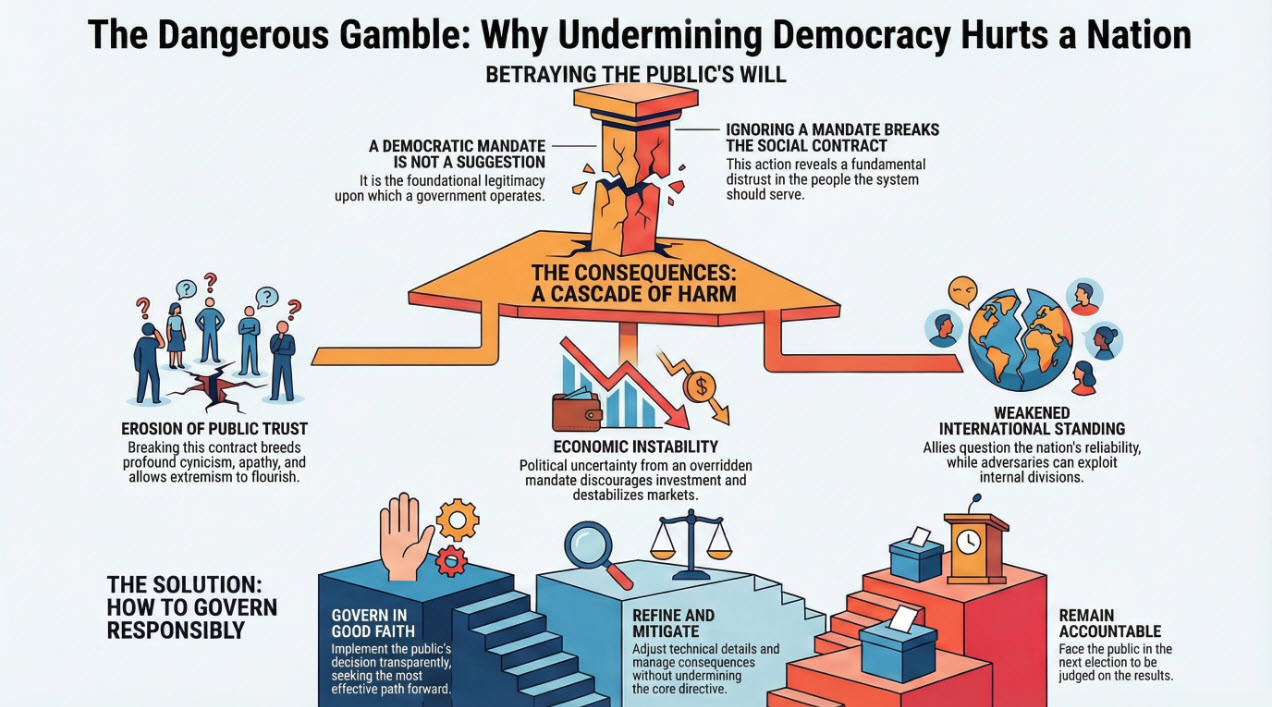
A democratic mandate is not a suggestion box; it is the foundational legitimacy upon which governments operate. When voters express their will through a free and fair election, they grant authority to their chosen representatives. Ignoring, delaying, or cancelling that mandate doesn’t demonstrate prudent leadership—it reveals a fundamental distrust in the very people the system is meant to serve. This act, whether through procedural sabotage or outright election suspension, inflicts deep, lasting wounds on a nation’s social fabric, economic stability, and international standing. The national interest is not a static concept defined by elites but a living ideal forged through public consent and institutional integrity.
The High Cost of Democratic Betrayal: Erosion of Trust and Stability
When a clear electoral outcome is sidelined, the immediate casualty is public trust. Citizens participate in elections based on an implicit social contract: that their vote matters and the result will be respected. Breaking this contract breeds profound cynicism. Voters who feel their participation is conditional—honored only when convenient for those in power—logically disengage. This leads to declining voter turnout, a rise in political apathy, and the dangerous vacuum that allows extremism and conspiracy theories to flourish.
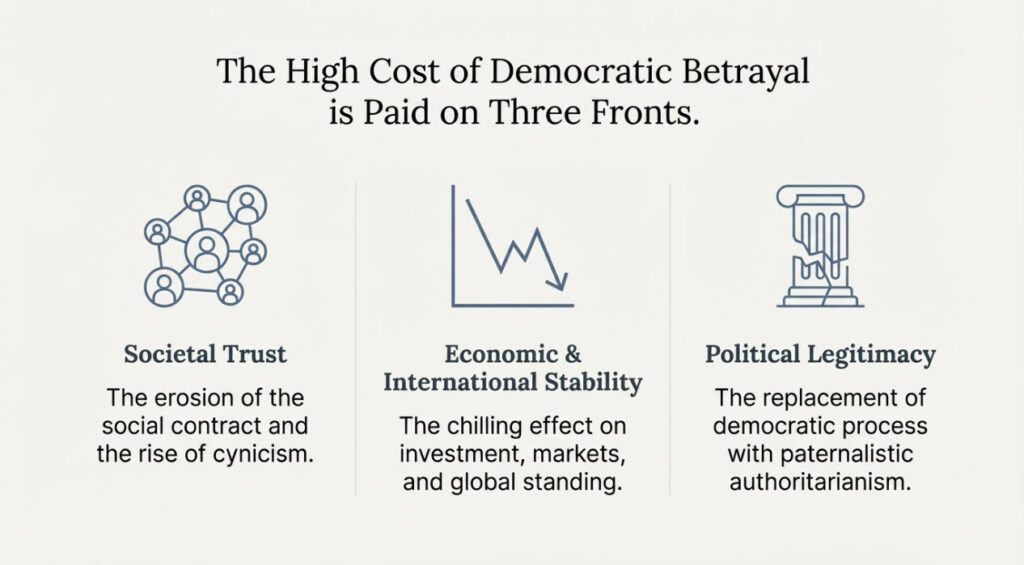
The damage is not merely abstract. As noted by Jason Patchett, markets and international partners depend on predictability. A government that overrides its own democratic mandate creates prolonged political uncertainty. This uncertainty discourages long-term domestic and foreign investment, destabilizes currency markets, and can lead to capital flight. Allies begin to question the reliability of a partner whose internal governance is unstable, while adversaries are presented with a golden opportunity to exploit visible societal divisions.
CLICK HERE to read the BBC article by Kier Starmer
The False Promise of “Stability” Through Suspension
Proponents of undermining mandates often cloak their actions in the language of necessity. They argue that extraordinary circumstances—economic crises, security threats, or political turmoil—require “temporary” suspensions of democratic norms to restore order. This is a seductive but perilous argument. Democracy already contains its own corrective mechanisms: robust parliamentary debate, judicial review, a free press, and the ultimate accountability of the next election.
Replacing these built-in safeguards with top-down, post-facto elite judgment is not stability; it is paternalistic authoritarianism. It assumes that the public cannot be trusted with their own governance during difficult times. History consistently shows that such moves do not prevent chaos but reliably provoke a powerful and often destabilizing backlash, as citizens resist the removal of their rights. The path to genuine, resilient stability runs through honoring commitments, not breaking them.
Case in Point: The UK’s Post-Breift Shift and the Language of the “National Interest”
The contemporary political landscape offers a clear lens through which to examine this principle. The recent shift in the UK’s approach to the European Union provides a pertinent example. Following the 2016 Brexit referendum and subsequent elections fought on implementing that decision, a clear democratic mandate was established. The debate then rightly moved to how to implement it, not whether to.
However, the political discourse continues to evolve. As of 2026, UK Prime Minister Keir Starmer has stated a readiness to pursue “closer alignment with the EU ‘in the national interest.'” This framing is crucial. It represents a post-mandate refinement of policy, undertaken by a government with a fresh electoral mandate of its own. The key distinction is that this shift is being proposed through normal democratic channels—debate, policy formulation, and legislative action—not by nullifying the original Brexit mandate after the fact.
This example underscores a critical nuance: democracy is dynamic. A mandate for a general direction does not fossilize policy for all time. New governments with new mandates can and should recalibrate approaches based on current circumstances. The breach of trust occurs not when policy adapts, but when the foundational democratic expression itself is disregarded or the rules of participation are changed to prevent an undesired outcome.
How to Honor a Democratic Mandate Without Abandoning Governance
Respecting a democratic mandate is not an instruction for robotic, unthinking implementation. It establishes a framework for legitimate governance. Responsible leaders can and should:
- Govern in Good Faith: Implement the decision transparently, seeking the most effective path forward.
- Refine and Mitigate: Adjust technical details, manage unforeseen consequences, and seek broad compromise on execution without undermining the core directive.
- Remain Accountable: Stand before the public in the next election to be judged on the results of their actions.
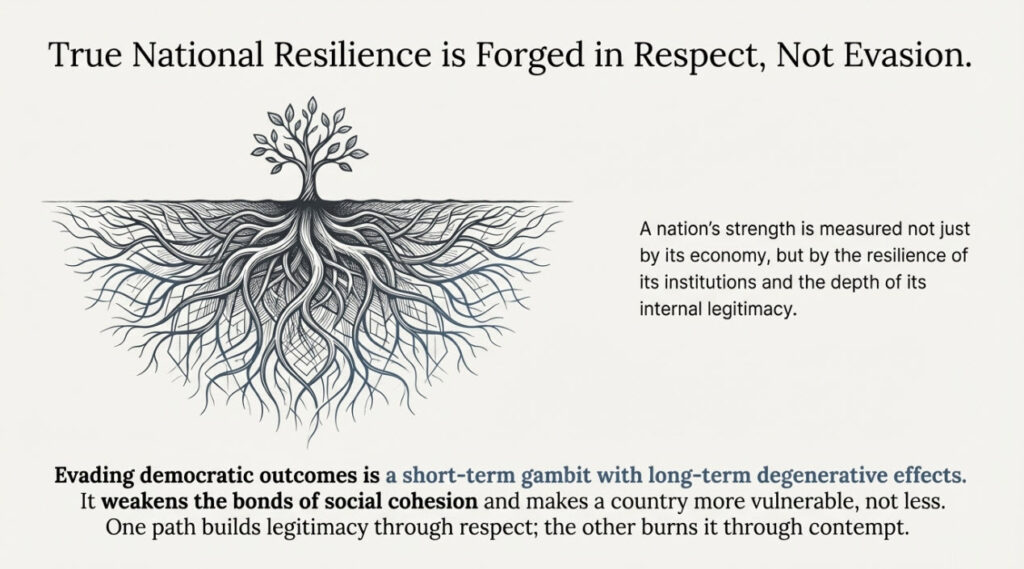
This process is the exact opposite of cancelling an election or using procedural tricks to indefinitely delay a result. One builds legitimacy through respect; the other burns legitimacy through contempt.
Conclusion: Resilience is Forged in Respect
A nation’s true strength is measured not just by its economic or military power, but by the resilience of its institutions and the depth of its internal legitimacy. Evading democratic outcomes is a short-term gambit with long-term degenerative effects. It weakens the bonds of social cohesion and makes a country more vulnerable, not less.
A country confident enough to respect its voters—especially when their choice is difficult or inconvenient—builds a deeper, more durable stability. It fosters a civic culture where citizens believe in their system, even when they disagree with specific outcomes. This faith is the ultimate national interest. Protecting it requires vigilance against the slow erosion of democratic norms, and an unwavering commitment to the principle that the people’s verdict, however delivered, must be honored. The path forward for any healthy democracy lies not in sidelining the public will, but in courageously embracing it.

If you want assistance with this article, please Contact Us


